


Why CPC Is Essential
1. Your Main Cost Control Lever
If you don’t monitor your CPC, your ad budget can vanish in an instant. With €100, a €10 CPC gives you 10 clicks; lower it to €2, and you get 50. More clicks = more conversion opportunities.
2. It Directly Impacts Profitability
Your CPC directly affects your ROAS (Return on Ad Spend). If you sell a €50 product and pay €5 per click, you need fast conversions to stay profitable. Lower your CPC to €1, and you instantly increase your margins and profit potential.
3. It Shapes Your Campaign Strategy
Advertisers constantly adjust bids and audiences to find the perfect balance between cost and performance. Bid too high? You overspend. Too low? You lose visibility.
4. It Enables Channel Comparison
Since CPC is a universal metric, it lets you compare performance across Google Ads, Facebook, TikTok, LinkedIn, or Meta Ads to identify where your budget performs best.
In short: CPC is the speedometer of your campaigns. Ignore it, and you’re driving blind.
CPC and Other KPIs: A Strategic Relationship
CPC alone is useful, but it becomes truly meaningful when connected to other key performance indicators (KPIs).
- CPC + CTR (Click-Through Rate): a high CPC is fine if CTR is strong — proof your users are engaged. Low CTR with a high CPC? Bad sign.
- CPC + Conversion Rate (CR): a low CPC is pointless if no one converts.
- CPC + CPA (Cost Per Acquisition): CPC directly affects CPA. Example: €2 per click × 10 clicks per sale = €20 CPA.
- CPC + ROAS: low CPC + steady conversions = high ROAS. The dream combo.
How to Calculate CPC
Formula: CPC = Total Ad Spend ÷ Total Clicks
Example: €200 spent for 400 clicks = €0.50 CPC.
- Track your spend and clicks on your ad platforms.
- Compare your CPC against industry averages.
- Optimize your targeting and creatives.
- Monitor trends and adjust regularly.
Good or Bad CPC?
A good CPC keeps you profitable. A bad CPC drains your budget without results. It often comes from broad targeting, high competition, or poor ad relevance.
How to Set CPC Goals
- Determine your AOV (Average Order Value) and CR (Conversion Rate).
- Calculate your break-even CPC: AOV ÷ (1 ÷ CR).
- Set a target CPC 20–40% below that threshold.
- Compare with market averages.
- Reassess your performance every 1–3 months.
Why CPC Alone Can Be Misleading
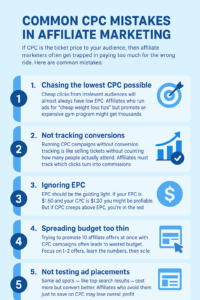
In affiliate marketing, CPC doesn’t tell the whole story. A high CPC can still be profitable if conversions are strong, while a low CPC can be worthless if the traffic doesn’t convert.
For a more accurate picture, track your EPC (Earnings Per Click) — your average revenue per click.
Want to dive deeper into lead generation? 📘 Everything You Need to Know About Cost Per Lead (CPL) in Affiliate Marketing – The Complete Guide.
How to Lower CPC Without Sacrificing Quality
- Refine your targeting.
- Improve ad relevance and Quality Score.
- Use long-tail keywords.
- Test your ad creatives.
- Run retargeting campaigns.
CPC for Advertisers and Agencies
Clients love CPC for its budget transparency.
Agencies use it to measure campaign efficiency and performance.
In both cases, CPC remains synonymous with visibility and strategy.